Iceland at a glance
| Best months | November to March for Northern Lights and winter landscapes; February and March provide a more balanced combination of darkness and increasing daylight |
| Typical winter temperatures | About -2 to +4°C in inhabited coastal areas, with the south coast generally mildest; highlands and the northern interior are colder, while wind can make conditions feel harsher |
| Currency | Icelandic krona (ISK) |
| Approximate seven-day ground budget | ISK 96,000–223,000 (approx. £580–£1,340) per person, excluding international flights |
| Winter Experience Score | 8.0/10: snow 6.5, nature and wilderness 9, winter experiences 8.5, uniqueness 10, value 6 |
| Best for | Winter photography, glaciers, seasonal ice caves, volcanic landscapes, black coasts, waterfalls and geothermal bathing |
| Main winter destinations | Reykjavik, Golden Circle, South Coast and Vik, Vatnajokull and Jokulsarlon, Snaefellsnes Peninsula |
Iceland's overall position reflects the five-criterion comparison, not a lack of winter appeal. Its uniqueness score is 10/10, while its lower snow and value scores reduce the arithmetic average.
Why visit Iceland in winter?
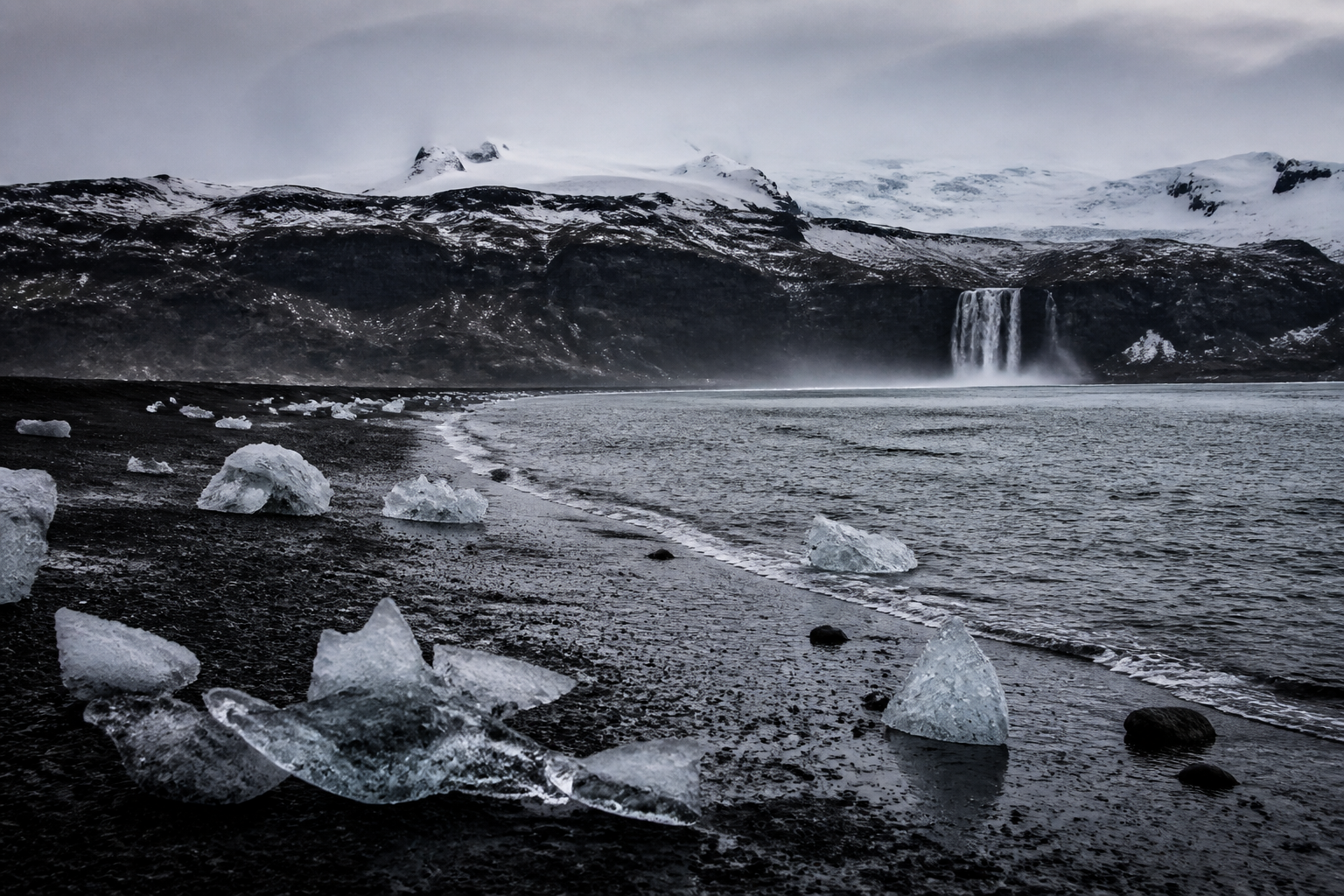
Iceland's strength is visual and geological concentration. Glaciers, waterfalls, black beaches, lava-shaped terrain and geothermal features can appear within one regional itinerary. Winter adds low light, ice formations and the possibility of aurora, creating a compelling set of photographic subjects even when the coast is not continuously snow-covered.
Vatnajokull and Jokulsarlon supply the glacial core, with ice, icebergs and seasonal cave experiences. The South Coast adds waterfalls, dark shorelines and volcanic forms; the Golden Circle introduces geysers and another group of familiar landscapes; Snaefellsnes compresses coast, mountain and volcanic scenery into a smaller peninsula. Reykjavik works as the practical starting point and a base for organised excursions.
The country is therefore different from a pure snow destination. Iceland ranks sixth in Snow and Real Winter because persistent coastal snow and broad snow-sport terrain are less dependable than in Japan, Canada, Finland or the featured regions of Russia and Norway. It ranks first for photography because the thematic score rewards visual uniqueness, landscape variety and signature phenomena. Iceland receives 10/10 in all three of those components.
Principal strengths: unmatched glacial, volcanic, coastal and geothermal contrasts; strong winter photography; good aurora potential during dark months; relatively moderate coastal temperatures for the latitude; and access to many major landscapes from Reykjavik on organised outings.
Principal trade-offs: high accommodation, dining, vehicle and activity costs; rapidly changing wind and weather; limited daylight around the solstice; less dependable coastal snow; and roads or highland areas that may be unsuitable for ordinary winter travel.
Best winter destinations in Iceland
These destination summaries use only the existing country record. They explain the best use of each place without inventing local budgets, temperatures or detailed transport instructions.
Reykjavik
Reykjavik is the practical base for an Iceland winter trip and the clearest choice for travellers who prefer organised day tours to independent winter driving. It offers access to the Golden Circle, aurora outings and other nearby landscapes while providing an urban element between weather-dependent excursions.
It is best for a first visit or a short itinerary that needs flexibility. The city is not itself the reason Iceland ranks first for photography, but it makes several major landscape experiences easier to organise.
Golden Circle
The Golden Circle contributes geysers, waterfalls and volcanic or geothermal character to Iceland's winter portfolio. It is best used as a concentrated introduction to the country's geological variety, particularly when paired with Reykjavik rather than treated as a complete winter holiday on its own.
Winter light and ice can change familiar scenes, but snow cover should not be assumed. Wind, road conditions and available daylight still determine how much can be experienced in one day.
South Coast and Vik
The South Coast and Vik provide the country's most recognisable contrast between dark coastline, waterfalls, glacial surroundings and volcanic landforms. They are especially strong for landscape photography and travellers who want dramatic scenery without making skiing the focus of the trip.
This region illustrates Iceland's weather trade-off clearly. Rapid changes in wind, precipitation and roads can alter the plan, so it is best approached with flexible timing rather than a rigid sequence of stops.
Vatnajokull and Jokulsarlon
Vatnajokull and Jokulsarlon are the main choices for glacial winter experiences. Guided glacier hiking, seasonal ice caves, icebergs and frozen detail make this the strongest part of the country for ice photography. Qualified guidance is central to glacier and cave access.
The area is best for travellers who put ice and geological scenery above conventional snow sport. Cave access and appearance are seasonal, while guiding and accommodation can push costs above the national baseline.
Snaefellsnes Peninsula
Snaefellsnes adds a compact mix of coast, mountain and volcanic scenery. It is relevant to photographers and travellers wanting a visually varied peninsula without relying only on the Golden Circle or South Coast.
Its best use is as a landscape-focused component of a flexible itinerary. Coastal exposure means weather can change quickly, and a winter visit should not depend on one exact viewpoint or a guaranteed snowy foreground.
Best winter experiences
- Photograph glaciers and black coasts: The contrast between bright ice, dark rock and ocean is central to Iceland's first-place photography score.
- Join a guided glacier hike: Qualified support opens a glacial environment that should not be treated as ordinary independent terrain.
- Visit a seasonal ice cave: Ice formations are among the country's strongest signature winter subjects, but access depends on current professional assessment.
- Bathe in geothermal water: Warm water against cold air and volcanic surroundings creates Iceland's defining hot-and-cold experience.
- See waterfalls, geysers and volcanic landscapes: The Golden Circle and South Coast make geological variety central to the trip.
- Look for the Northern Lights: Dark winter nights provide good potential, but cloud and rapid weather changes reduce reliability.
- Use changing light for photography: Short days, long twilight and fast-moving conditions can be creatively valuable even when they complicate planning.
When to go
November to March is the broad period for dark skies, winter landscapes and aurora potential. February and March usually provide the most balanced combination of darkness and increasing daylight, making them useful for travellers who want both night photography and more time at daytime landscapes.
The winter solstice period offers very limited daylight. Later winter improves usable hours but does not guarantee snow or clear skies. Glacier and ice-cave experiences follow current seasonal conditions and professional operating decisions, while aurora depend on cloud, darkness and solar activity.
Winter costs
The existing seven-day ground benchmark is ISK 96,000–223,000 (approx. £580–£1,340) per person, excluding international flights. It represents broad budget-to-mid-range national spending rather than a complete guided photography or glacier itinerary.
Car rental, winter accommodation, glacier hiking and seasonal ice-cave tours can increase the total. Rebooking or changing plans around weather may also affect practical costs. No separate budgets are assigned to Reykjavik, the Golden Circle, South Coast, Vatnajokull or Snaefellsnes because destination-level figures have not been established.
Practical UK entry information
British citizens can visit Iceland and the wider Schengen area visa-free for up to 90 days in any 180-day period. The passport must have been issued less than 10 years before arrival and expire at least three months after the planned Schengen departure. EES biometric registration may be required.
These formalities are separate from the Winter Experience Score. Check the current official UK entry information again before travel.
What travellers say
Travellers frequently praise Iceland's winter waterfalls, glaciers, ice caves and rapidly changing light. The South Coast and Golden Circle remain popular because they concentrate several of the country's major subjects, while geothermal bathing adds a contrasting experience after time outdoors.
Many reports say the trip is most rewarding when the itinerary remains flexible and aurora are treated as a bonus rather than a guarantee. Repeated difficulties are wind, ice, short daylight and sudden road or weather changes that force last-minute revisions. This is an aggregated summary of existing discussions, not a set of direct quotations.
Where Iceland ranks
Iceland is sixth overall and sixth for Snow and Real Winter, but first for Winter Photography with 9.8/10. The contrast is methodologically consistent: the overall score includes snow reliability and value, while photography heavily rewards the visual and geological uniqueness in which Iceland receives maximum component scores.
| Ranking | Position | Score |
|---|---|---|
| Winter tourism | #6 | 8.0/10 |
| Snow and a real winter | #6 | 7.9/10 |
| Northern Lights winter trip | #5 | 8.1/10 |
| Winter wilderness | #4 | 8.7/10 |
| Winter adventure | #6 | 8.6/10 |
| Winter photography | #1 | 9.8/10 |
FAQ
Is Iceland good for a winter holiday?
Yes, particularly for glaciers, ice caves, waterfalls, volcanic scenery, geothermal bathing and photography. It is less suitable for travellers whose only priority is guaranteed deep snow or a low-cost trip.
Why does Iceland rank sixth overall but first for photography?
The overall score includes snow reliability and value, where Iceland is weaker than several competitors. Photography rewards visual uniqueness, landscape variety and signature phenomena, and Iceland receives maximum component scores in all three.
What is the best place to visit in Iceland in winter?
The South Coast and Vatnajokull area provide the strongest mix of glaciers, waterfalls, dark coastline and ice experiences. Reykjavik is the most practical base, while the Golden Circle and Snaefellsnes add further geological variety.
When is the best time to visit Iceland in winter?
November to March is the broad winter window. February and March are usually the best balance for darkness, longer daytime exploration and winter atmosphere.
Can I see the Northern Lights in Iceland?
Yes, dark winter nights provide good potential. Cloud, rapid weather changes and solar activity determine individual sightings, so aurora should be treated as a possible highlight rather than a guarantee.
How much does a winter trip to Iceland cost?
The broad seven-day ground benchmark is ISK 96,000–223,000 (approx. £580–£1,340) per person, excluding international flights. Vehicle hire, glacier tours, ice caves and winter accommodation can increase the total.
Does Iceland have reliable snow in winter?
Not everywhere. Glaciers and ice experiences are strong, but inhabited coastal areas can be mild and persistent snow is less dependable than in the leading snow countries. Wind and rapidly changing conditions are often more important than the air temperature alone.
Sources & notes
Facts and traveller sentiment were checked on 20 August 2026. This page uses only the existing Iceland references:
- Iceland entry requirements
- Icelandic Met Office climate report
- Visit Reykjavik seasonal guide
- Iceland travel costs
- Iceland winter trip report
- Iceland winter-driving report
- Iceland winter road-trip report
GBP equivalents are approximate and use exchange rates checked on 20 August 2026. Actual exchange rates may vary.