Finland at a glance
| Best months | December to March; January to March generally provides the most dependable combination of snow and winter activities in Lapland |
| Typical winter temperatures | Approximately 0 to -15°C in the main winter regions, with milder southern coasts and colder northern Lapland; severe cold spells can fall below -30°C |
| Currency | Euro (EUR) |
| Approximate seven-day ground budget | EUR 525–1,270 (approx. £450–£1,090) per person, excluding international flights |
| Winter Experience Score | 8.3/10: snow 9, nature and wilderness 8, winter experiences 9.5, uniqueness 8, value 7 |
| Best for | Reliable Lapland snow, huskies, reindeer, cross-country skiing, snowmobiling, sauna and accessible Arctic activities |
| Main winter destinations | Rovaniemi, Levi, Saariselka and Inari, Ruka and Kuusamo, Finnish Lakeland |
Finland's most dependable winter proposition is in Lapland. Southern coastal conditions are milder and less reliably snowy, so the national temperature range should not be applied uniformly.
Why visit Finland in winter?
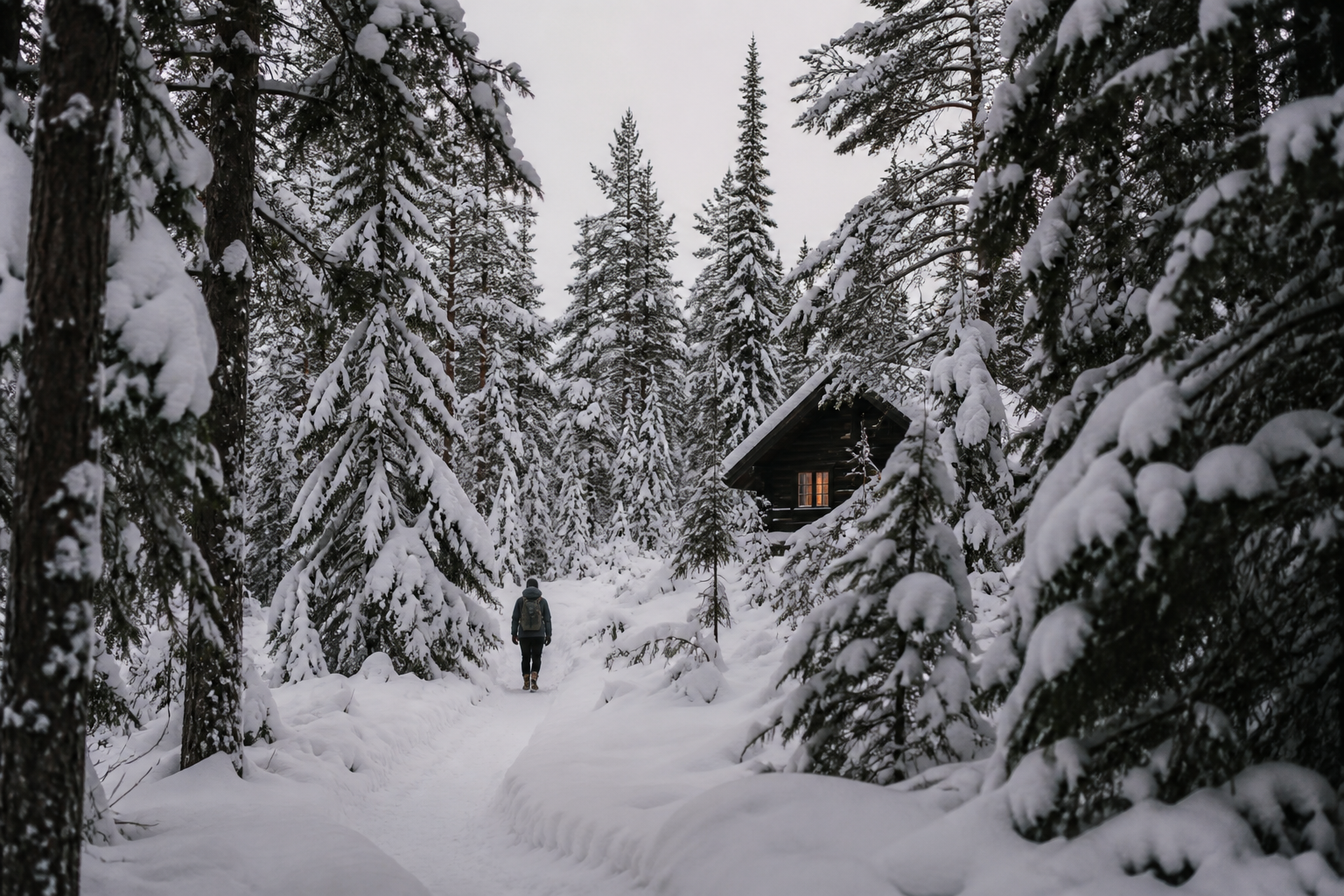
Finland's main advantage is coherence. Snow-covered forests, frozen lakes and low fells create a consistent northern setting, while mature tourism infrastructure makes a wide range of activities available from established bases. Husky trips, reindeer experiences, snowmobiling, downhill and cross-country skiing, sauna and winter swimming can form one balanced week.
Lapland also offers strong Northern Lights potential away from urban light. Finland ranks third in the complete aurora comparison because dependable snow and an unusually broad supporting activity programme make the trip worthwhile even if cloud obscures the sky. The lights should still be treated as weather-dependent rather than promised.
Cross-country skiing is a particular strength. Extensive trail culture and long Lapland snow seasons support active travel that is less terrain-intensive than Norway's coastal mountains or Canada's Rockies. This helps Finland suit families, first-time Arctic visitors and mixed groups in which only some travellers want downhill skiing.
The landscape is understated rather than weak. Forests, fells and frozen lakes do not produce the same dramatic landform variety as Icelandic geology or Norwegian fjords, but they create a calm, recognisably wintry setting for aurora, sledding and trail activities. That consistency explains why Finland scores better for snow and organised adventure than for wilderness scale or photographic uniqueness.
Principal strengths: long and dependable Lapland snow; well-developed infrastructure; broad and accessible Arctic activities; strong aurora potential away from light pollution; and excellent cross-country skiing.
Principal trade-offs: peak accommodation and activities are expensive; midwinter daylight is very short in the far north; southern snow is less reliable; and popular resorts can become busy around Christmas and New Year.
Best winter destinations in Finland
The summaries below describe the role of each destination using only country-level information. No unsupported local prices, temperatures or detailed transport instructions are added.
Rovaniemi
Rovaniemi is the most convenient and family-oriented base in Finland's winter set. It supports a broad programme of huskies, reindeer, snowmobiling, sauna, winter landscapes and Northern Lights outings, with a more urban setting than the smaller northern bases.
It is best for a first Lapland holiday or a mixed group that values choice and organisation. Traveller discussions often describe it as convenient, while some visitors prefer Levi or smaller bases for skiing and a less urban atmosphere.
Levi
Levi is the clearest choice for travellers making downhill skiing a major part of the week. It combines developed resort facilities with access to the wider Lapland activity set, so non-ski days can still include sledding, snowmobiling, sauna or aurora outings.
Its best use is a structured resort holiday with a broad supporting programme. Peak dates can be busy and expensive, particularly when premium accommodation and several guided activities are added.
Saariselka and Inari
Saariselka and Inari represent the quieter, more northerly side of Finnish Lapland. Forests, fells, frozen landscapes and dark skies make them especially relevant to aurora, cross-country skiing and travellers seeking a stronger sense of Arctic nature.
They are best for a snow-first itinerary that values calm surroundings over an urban base. Midwinter daylight is limited, while February and March provide more light without removing the established winter setting.
Ruka and Kuusamo
Ruka and Kuusamo combine snow sport with forest-led outdoor experiences. They are suited to travellers who want downhill or cross-country skiing, snowmobiling and quieter nature activities within a developed winter destination.
This pairing offers a middle ground between Rovaniemi's convenience and the far-northern character of Saariselka or Inari. It is best used for an active week rather than a trip built only around aurora.
Finnish Lakeland
Finnish Lakeland provides the broadest frozen-lake and forest interpretation of the country's winter identity. It is relevant to sauna, winter swimming, cross-country skiing and quiet nature rather than high-intensity mountain sport.
The region is best for a slower trip focused on cabins, water, forest and Finnish winter routines. Snow reliability is more dependent on latitude and season than in northern Lapland, so the national January-to-March guidance remains broad.
Best winter experiences
- Go husky sledding: This is one of the most consistently praised Lapland activities and a natural fit with forest and trail environments.
- Try reindeer experiences and Sami cultural activities: These add regional context to a snow holiday and broaden the programme beyond sport.
- See the Northern Lights: Northern destinations provide strong potential, particularly away from light pollution, but cloud and solar activity remain decisive.
- Cross-country or downhill ski: Finland combines resort access with an extensive trail culture and dependable northern snow.
- Use a snowmobile: Organised routes add range across forest, fell and frozen-lake settings.
- Combine sauna with winter swimming: The hot-and-cold contrast is one of Finland's clearest cultural winter experiences.
- Stay under a glass roof: Glass cabins are a recognisable Lapland option, though they can materially increase costs and do not guarantee aurora.
When to go
December to March is the main season for a full winter trip. January to March generally gives the strongest combination of dependable snow and operating winter activities in Lapland. Christmas and New Year bring a distinctive atmosphere but also crowds, high prices and very short daylight.
February and March are often the most balanced months because snow remains established while days become longer. Southern Finland and the coast do not match Lapland's reliability, so travellers prioritising deep snow should choose a northern base rather than assume the whole country offers identical conditions.
December remains attractive for travellers specifically seeking Christmas atmosphere, while January emphasises deep midwinter and short days. The correct choice is therefore not simply the coldest month: daylight, crowd levels, activity priorities and the preferred Lapland base should be considered together.
Winter costs
The existing seven-day ground benchmark is EUR 525–1,270 (approx. £450–£1,090) per person, excluding international flights. It represents broad budget-to-mid-range national spending rather than a complete premium Lapland package.
Glass cabins, husky or reindeer excursions, snowmobiles and multiple guided aurora outings can add considerably. Christmas and New Year accommodation may also sit above the baseline. No destination-specific figures are assigned because separate budgets have not been established for Rovaniemi, Levi, Saariselka, Ruka or Lakeland.
The practical implication is to choose the paid experiences that matter most before selecting premium accommodation. A broad activity list and a glass-roofed stay can both be appealing, but combining every headline option is not represented by the basic country range.
Practical UK entry information
British citizens can visit Finland and the wider Schengen area visa-free for up to 90 days in any 180-day period. The passport must have been issued less than 10 years before arrival and expire at least three months after the planned Schengen departure. EES biometric registration may be required at the border.
This summary follows the existing country record. Entry rules are separate from the Winter Experience Score and should be checked again before travel.
What travellers say
Travellers frequently praise Finnish Lapland for deep snow, quiet forests, husky trips, saunas and the ability to choose among many winter activities. Rovaniemi is often described as convenient and family-friendly, while Levi and smaller bases appeal to travellers seeking skiing or a less urban setting.
The recurring criticisms are cost, Christmas crowds and uncertainty around the aurora. Premium accommodation and short guided activities can make a simple itinerary expensive, and a glass roof does not remove cloud. The sentiment here aggregates existing public trip reports without inventing quotations or identities.
Where Finland ranks
Finland performs best where dependable snow and a complete organised Arctic programme matter. Its lower wilderness and photography positions reflect gentler, more repetitive forest-and-lake landforms rather than weak winter conditions.
| Ranking | Position | Score |
|---|---|---|
| Winter tourism | #5 | 8.3/10 |
| Snow and a real winter | #4 | 9.1/10 |
| Northern Lights winter trip | #3 | 9.0/10 |
| Winter wilderness | #5 | 8.6/10 |
| Winter adventure | #5 | 9.0/10 |
| Winter photography | #6 | 8.5/10 |
FAQ
Is Finland good for a winter holiday?
Yes. Finland is one of the most dependable choices for Lapland snow and an organised mix of huskies, reindeer, skiing, snowmobiling and sauna. It is especially suitable for families and mixed-activity groups.
Where is the best place in Finland for winter?
Rovaniemi is the most convenient all-round base, while Levi is stronger for a resort-led ski trip. Choose Saariselka and Inari for a quieter northern setting, Ruka and Kuusamo for active nature, or Lakeland for cabins and frozen-water scenery.
When is the best time to visit Finnish Lapland?
January to March provides the most dependable balance of snow and winter activities. February and March add more daylight, while Christmas and New Year are atmospheric but busier and more expensive.
Can I see the Northern Lights in Finland?
Yes, northern Finland has strong aurora potential away from light pollution. Sightings still depend on darkness, clear cloud conditions and solar activity, so plan several nights and other daytime experiences.
How much does a winter trip to Finland cost?
The broad seven-day ground benchmark is EUR 525–1,270 (approx. £450–£1,090) per person, excluding international flights. Glass cabins and multiple guided activities can raise the total considerably.
Is Finland suitable for non-skiers in winter?
Yes. Husky and reindeer experiences, snowmobiling, sauna, winter swimming, aurora outings and forest or lake scenery provide a complete non-ski programme. Cross-country skiing also offers a gentler alternative to downhill resorts.
Does all of Finland have reliable winter snow?
No. Lapland has the longest and most dependable snow season, while southern coastal areas are milder and less consistent. Travellers prioritising deep winter should choose a northern destination.
Sources & notes
Facts and traveller sentiment were checked on 20 August 2026. This page uses only the existing Finland references:
- Finland entry requirements
- Finnish Meteorological Institute: seasons in Finland
- Visit Finland winter overview
- Finland travel costs
- Finnish Lapland trip report
- Finland winter solo-trip report
- Lapland December discussion
GBP equivalents are approximate and use exchange rates checked on 20 August 2026. Actual exchange rates may vary.